Introduction
The peaceful uprising against the regime of Syrian President Bashar al-Assad, which broke out 12 years ago, has turned into a full-scale civil war. The conflict has left more than 380,000 people dead, devastated Syrian cities and dragged other countries into it.
The Syrian crisis has moved into a conflict between the great powers of Russia, the United States of America, Iran, Turkey and Israel, and the Syrian issue has become one of the most complex political issues in modern history.
War crimes and crimes against humanity have been committed in Syria while chemical weapons have been used by the Syrian regime on many occasions and in many places, according to a report by the United Nations Organization for the Prohibition of Chemical Weapons, although the regime has not yet been held accountable.
During the Syrian war, many meetings calling for a political solution in Syria have occurred, such as the Geneva, Sochi and Astana conferences which took place thanks to the initiative of Arab countries and other powers interested in the Syria file. However, all these initiatives and efforts failed because of the procrastination of the Syrian regime and its allies represented by Russia and Iran. The initiatives failed also due to the overlap of goals and interests of the countries active in the Syrian file resulting in clashes and complications between the actors inevitably leading to the complexity of the Syrian file making it an even more difficult and complex file.
UN investigators say tens of thousands of civilians in Syria are still missing after being arbitrarily detained.
Thousands more were tortured to death while in detention according to recent reports detailing alleged war crimes and crimes against humanity committed by all parties to the conflict in Syria. At the same time, the international community’s procrastination and impunity for the Syrian regime’s crimes meant the Syrian people have been subjected to great massacres and suffering under bitter humanitarian conditions, whether in the countries they have been accorded asylum, or in the camps or even inside Syria. With the stagnation of the political solution and its cessation in Syria, and ongoing developments in the world such as the war in Ukraine and the Iranian Revolution, a clash of forces may be possible in Syria which may perhaps lead to a eventual solution to the Syrian file after the political exchanges have failed leaving the military option as the only alternative.
Methodology
The descriptive analytical approach was adopted, which depends on describing phenomena and events and analyzing them into their primary factors, thus revealing the relationships between variables and events and predicting what will occur based on observation and political, military and popular movements that occur in the Syrian file.
Operations
Results
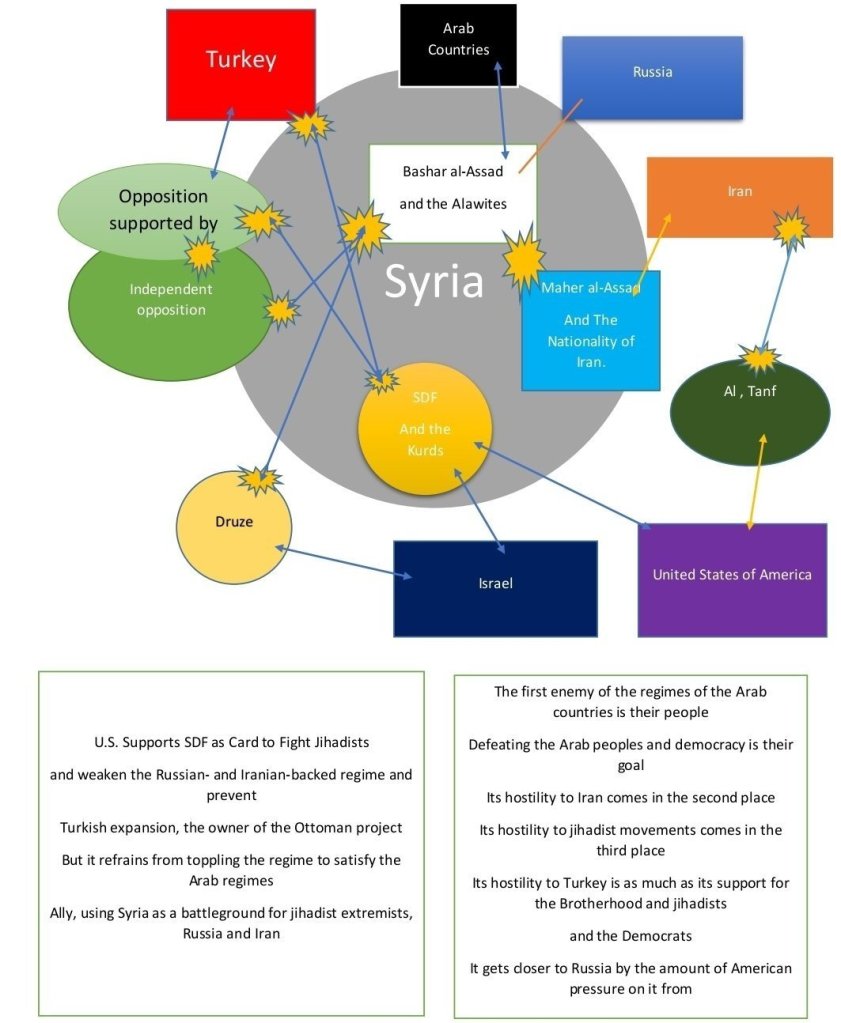
The rapprochement between Turkey and the regime is a tactical rapprochement that will end with the Turkish elections. Turkey‘s only enemy is the question of Kurdish secession with no other strategic enemy. The tension between Turkey and the rebellious Syrian people is temporary.
The rapprochement of Arab countries and Assad is firm proving them to be the third enemy of the Syrian people’s revolution after Iran and Russia. Israel’s support for this conciliatory path between Turkey and the Arabs, on the one hand, and Bashar al Assad, on the other hand, is tactical while waiting for the Turkish elections and Russia’s defeat in Ukraine. Israel has no enemy except Iran’s hegemony over Syria to threaten it.
After the weakening of Russia and Turkish elections, alliances will change and America’s protection of Iran, Assad and the SDF will end, and it will increase.
Starting next fall, America, Israel and Europe will engage in the process of restoring stability in the region, which means a weakening of the Iranian regime and the resistance alliance, including the Brotherhood, while remaining keen to prevent Turkish expansion by supporting the Turkish opposition in order to win.
The current map of control will not change, but Iran will disappear from the Syrian stadium and with it the authority of Assad and his brother and the Alawites will shrink to the coast where Russian influence prevails. A limited Turkish influence will continue in the north, in parallel and counter balanced with the Kurdish component, while the operation to liberate Damascus, the south and the Badia will be launched with the support of the coalition, America, Israel and Jordan. Turkey will remain outside the process. That is, Turkey will not gain more influence in Syria and will maintain its current influence in northwestern Syria.
Those who will demand federalism in Syria are the Alawites and Kurds, and perhaps the Druze and the areas controlled by the Brotherhood in the north and Aleppo. Syria, in the transitional phase, will be a federal state as imposed by French colonialism with the addition of a fifth component, the Kurdish, Damascus, Homs and Hama with Daraa and Badia, Aleppo, Idlib, Qamishli, Hasakah, Tartous and Latakia Sweida.
Restoring Syria’s unity will depend on the need for economic participation and not political consensus and the path of unification will start from Suwayda and then the north followed by the Kurds and then the Alawites.
With the success of the federal project in restoring Syrian stability, Lebanon, Jordan and the West Bank will join cooperation projects, and the creative chaos of Iran and Turkey will move to globalization in its course in the Middle East.


Leave a Reply